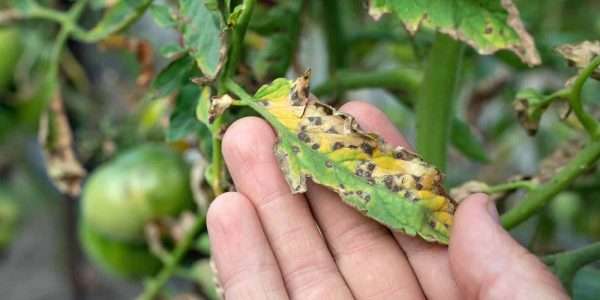
Spots on tomato leaves may be a sign that recent rains are doing more harm than good in your garden. According to Purdue Extension – Porter County, adequate moisture is necessary but with too much rain, and temperatures and humidity in the high 90s, homeowners have concerns about blight on tomatoes and their Colorado blue spruce trees turning brown.
“Blights are caused by fungal and bacteria-type organisms that spread rapidly in wet weather,” said John Nash, Master Gardener and manager of the Porter County Extension Hotline, who has received numerous calls about early tomato blight and Colorado blue spruce needle cast disease.
Tomato diseases spread by spores that require dew or rain to adhere to the leaf and then infect the plant. Thus they are most severe under wet conditions. Early tomato blight symptoms include spots on lower leaves after the first fruits set. Initially the fungus causes numerous, small, roughly circular spots, scattered randomly over the leaf. Spots enlarge to approximately 1/16 to 1/4 inch in diameter with dark brown borders and tan or light colored centers.
Colorado blue spruce needle cast is a fungal disease caused simply by being subjected to Midwest climatic conditions. The Colorado blue spruce requires normal moisture and possesses only moderate tolerance to flooding and drought, according to the Arbor Day Foundation.
“Any plant grown in less-than ideal conditions can become susceptible to insects and diseases that affect growth and aesthetic appeal,” Nash said. The key symptom of Colorado blue spruce needle cast disease is lower branch dieback and needle loss, which progresses and within a few years renders the plant’s appearance unacceptable for most homeowners.
Furthermore, the rapid decline of many non-native spruce trees in the Midwest appears to be related to an increase of canker diseases coupled with other disease and insect problems that plague these species. Unfortunately, when most people call the Porter County Hotline, tree damage is so severe it is past the treatment stage, or the tree is so large that treatment isn’t recommended or feasible.
“Fungicides are available,” Nash said, “but trees must be sprayed at the early stage of the disease before major needle and limb loss mar the tree’s appearance.” However, often the tree is too big for the homeowners to spray themselves and there can be additional costs for routine professional treatments. ” Perhaps the best way to avoid this potential problem is not to plant Colorado blue spruce, ” Nash said.
For more information see: “What is Spruce Decline and What Should You Do About It?” Michigan State University. For more information about any garden or small farm issues, call the Porter County Extension Office, 219-465-3444.
 Read More Gardening Tips
• Spring Landscaping Tips to Free Up Time in the Summer
(by Blain’s Farm and Fleet)
• Spring Landscaping Tips
by Sue Baxter
• 2020 Symposium
• What To Do About Brown Grass
by Purdue Extension
• Moisture Induced Diseases affecting Plants and Landscaping
by Purdue Extension
• Winter Gardening Tips from Purdue
• Protecting Your Garden from Cold Weather
(by Blain’s Farm & Fleet)
• Top Gardening Tips for a Fruitful Season
• Visit Friendship Botanic Gardens in Michigan City
• How to Make Your Garden Patriotic,by Cassie Steele
• The Greenhouse in East Chicago has Working Aquaponics
• Visit Gabis Arboretum
 Read More Home Improvement Tips, Click here.

Susie Young Baxter, CEO, has published PanoramaNOW Magazine for 31 years. Her hobbies are Camping, Boating, Hiking, Nature, Gardening and Outdoor Activities. She is an Artist, Graphic Designer, an Avid Seamstress, Dabbles in Homemade Crafts and Landscaping. Since her Father was a Health Teacher, she also likes homeopathic Health Solutions. Since blogging started over 10 years ago, PanoramaNow has been added to Newsbreak – a national news affiliate.


