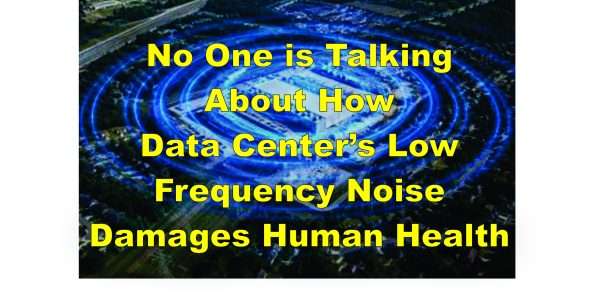
Do you know what Low Frequency Noise is? Well, if you don’t, you’re in good company, because neither does your City Council, or the Leaders approving the Data Centers being built next to where people live. Expansive parking lots and flat fields offer no protection against LFN dangers (also known as ‘”industrial rumble.”) The brain can process a train moving past that has a beginning and an end, the LFN from a Data Center never stops, permanently raising the ‘noise floor’ of the entire home, neighborhood and sometimes the entire county. Plus, Data Center’s LFN noise increases over time. *
A data center can comply with local municipal decibel limits and still produce an intrusive, low-frequency constant rumble or vibration that neighbors can hear or feel — especially at night when ambient background noise drops.
Low Frequency Noise (LFN) travels miles, not feet, and it can penetrate homes and buildings. Low-frequency sound waves carry enough physical energy to vibrate walls, windows, and floors. This causes a visceral “body feel” similar to standing near a bass subwoofer at a concert or that annoying noise coming from that car with the low bass you can hear and feel for blocks.
At 500 feet: The intensity is equivalent to a rock concert.
At 1,000 feet: The pressure wave is sufficient to rattle windows and interiors.
At a half mile: You will feel a steady, rhythmic ‘thump,’ like a car stereo bass that won’t turn off.
At one mile: You will feel a heavy reverberation or pressure in your ears.
Living with a constant 24/7 LFN noise that never stops is not the same as living near a highway or train tracks. Highway and rail traffic is intermittent — it passes, and silence returns. A data center is constant. It is a 24/7/365 industrial presence that never sleeps.
According to Wikipedia, “Low-frequency sounds (like bass notes or infrasound below 20 Hz) travel much farther than high-frequency sounds because they experience less atmospheric absorption (energy loss to the air) and bend easily around large obstacles through a process called diffraction.”
LFN Expands on Flat Land, the Data Center presents unique physical challenges that current noise ordinances ignore. And, claiming there is an “‘Ocean Breaker” effect or installing berms and landscaping only lowers High-frequency noise (like a bird chirp.) Low-frequency noise from data center machines and chillers is like an ocean swell. It doesn’t stop at your house; it wraps around it, passing through siding and windows with ease. https://www.larsondavis.com/applications/environmental-noise-monitoring/data-center-noise-monitoring
Room Mode’ Resonance: because the hum is constant, it can ‘tune’ the air inside a home or other structure. The energy enters through the concrete foundation and vibrates the air inside, causing the sound to become louder inside your bedroom or classroom than it is outside. For example, if a Semi-Truck is running and is parked outside of your home you certainly feel it. AND THE WORST PART, Once low Frequency Noise gets inside your home, it can’t be removed. It keeps building.
The Masking Problem: At 2 miles away, the ‘audible’ noise might be below the sound of crickets. Yet, the pressure remains. Residents describe this not as hearing a noise, but as ‘feeling’ a vibration in their chest or ears.
The City Ordinance Problem: Most community noise regulations offer noise limits in the 50 dB to 60 dB range. However, these regulations were not written with constant, low-frequency noise in mind. Data center noise occurs 24 hours a day, including overnight when ambient noise levels tend to be lower. A 50 dB noise during the daytime may not be annoying, whereas it would be noticeable at nighttime. In addition, many regulations were written to measure with A-weighted noise levels, so the lower frequency noise is not captured as well in the measurement.
HERE’S THE HUMAN HEALTH DANGERS:
Continuous noise keeps your nervous system in a mild “fight-or-flight” state. It raises levels of stress hormones like cortisol, which can increase blood pressure and raise the long-term risk of heart disease.
Sleep Disruption:
Deep hums can disturb the deepest stages of sleep. Even if you do not fully wake up, fragmented sleep leaves you tired, moody, and short on energy during the day.
Poor Concentration:
Background noise forces your brain to work harder to process information. Constant exposure makes it difficult to focus, solve problems, or perform complex mental tasks.
Mood and Mental Health: Long-term exposure links to higher rates of anxiety, depression, and generalized mental exhaustion.
Physical Discomfort:
Low-frequency sounds often cause physical sensations like vibrations, head pressure, muscle tension, and chronic headaches.
Low Frequency Noise Increases OVER TIME:
Mechanical Wear:
Bearings in massive cooling fans, chillers, and water pumps wear out. Worn parts create extra vibration and a deeper rumbling sound. Massive cooling systems, chillers, water pumps, transformers, compressors, pumps, blowers, ductwork, and server racks all create mechanical and electronic low frequency noise.
Higher Workloads:
As a facility adds more servers or upgrades to high-power processors (like artificial intelligence chips), cooling systems must run harder and faster to prevent overheating.
Degraded Insulation:
Rubber vibration mounts, acoustic barriers, and soundproofing materials dry out, crack, or loosen over time, reducing their ability to block sound.
Deferred Maintenance:
Unbalanced fan blades, loose panels, or un-serviced motors increase mechanical buzzing and humming.
Rubber Vibration Mounts:
These components experience constant mechanical stress and temperature fluctuations. Over time, the rubber mounts undergo a process called dry rot or oxidation, causing it to harden, crack, and lose its elasticity. Once brittle, they can no longer absorb mechanical oscillations, allowing vibrations to travel directly into the surrounding structure.
Acoustic Barriers:
High-density barriers (like Mass Loaded Vinyl) can stretch, sag, or tear, especially if they are hung vertically without proper support. When the material thins out or pulls away from its fasteners, sound waves can easily pass through the weakened areas.
Soundproofing Foam & Fiberglass:
Open-cell acoustic foams are highly susceptible to UV light, moisture, and oxidation. They eventually crumble into dust or compress, losing the open-cell structure required to trap and dissipate sound waves.
When the local County Council permitted the Amazon data center in New Carlisle, Indiana, they did not have the lived experience of dwelling in the shadow of a hyperscale facility. They still don’t — because Project Rainier is not yet fully operational. They are legislating in the dark. If no one is talking about LFN’s . . . then how can anyone be held financially responsible for mitigation at the source, or even shutting down operations?
MORE RELATED ARTICLES . . .

Here’s Several Peer Reviewed Scientific Reports On Data Centers
Many Pro Data Center proponents say there’s no Peer-Reviewed Data on Data Centers. Well, back in February 2026, there was an extensive Peer – Reviewed Scientific Report published. Many Alarming impacts have come out after Virginia’s Data Center boom started published by George Mason University, Fairfax, Virginia. This new and groundbreaking…
Valparaiso Begins Work on Data Center UDO (Unified Development Ordinances)
The city of Valparaiso is working on development and zoning regulations specifically addressing data centers. Data centers were the topic of discussion this evening at the October 6th, 2026 at the Plan Commission meeting. Currently Valparaiso has a moratorium on data centers, but it “Shall automatically expire upon the effective date of amendments…

Here’s Why NIPSCO Bills Keep Going Up
Indiana Lawmakers have passed laws that allow NIPSCO to Increase Fees. Many People are facing double and triple increases in their NIPSCO Bills this winter 2026 and are having extreme difficulty paying their bills. People in apartments face eviction, if their NIPSCO Bill is not paid. While NIPSCO states the increase is only only 16.74%, or $23 a month, local homeowners are facing 200% and 300% increases instead and NOT BECAUSE IT’S COLD! (See Temperatures and Fees on the NIPSCO Bills Below)
Continue Reading . . .

It’s Election Time, Here’s the Indiana Lawmakers that Allowed NIPSCO Increases for Data Centers
Indiana Lawmakers have passed laws that allow NIPSCO to Increase Fees. Many People are facing double and triple increases in their NIPSCO Bills this winter 2026 and are having extreme difficulty paying their bills. People in apartments face eviction, if their NIPSCO Bill is not paid. While NIPSCO states the increase…

EMF Concerns at Data Centers (And Mechanical Waves)
Data Centers pose greater net risks by creating “EMF Vibrations” that degrade the quiet and natural habitat wildlife relies on for food, reproduction, communication, navigation and survival. Furthermore, what most people are ignoring is the fact that there are High and Low Mechanical Waves and there are High and Low EMF Waves, each…

Alarming Health Implications from Virginia’s Data Center boom
Many Hobart Data Center proponents site the successes of Virginia’s Data Centers as an example of their “safe” uses. That was then, this is now. Many Alarming impacts have come out after Virginia’s Data Center boom started published by George Mason University, Fairfax, Virginia. A new groundbreaking study uncovers the alarming Health…

Susie Young Baxter, CEO, has published PanoramaNOW Magazine for 31 years. Her hobbies are Camping, Boating, Hiking, Nature, Gardening and Outdoor Activities. She is an Artist, Graphic Designer, an Avid Seamstress, Dabbles in Homemade Crafts and Landscaping. Since her Father was a Health Teacher, she also likes homeopathic Health Solutions. Since blogging started over 10 years ago, PanoramaNow has been added to Newsbreak – a national news affiliate.


